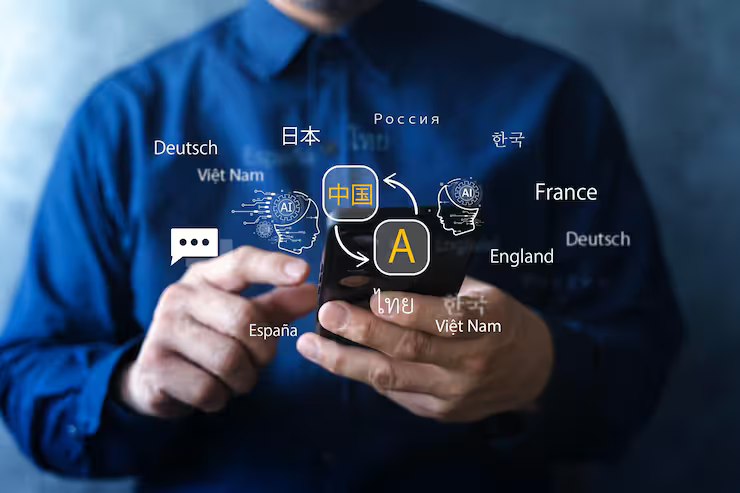
AI translation tools are changing how people communicate across languages in workplaces, education, travel, customer support, media, and online communities.
Instead of relying only on manually translated text, these systems can process large amounts of language data and generate translations within seconds.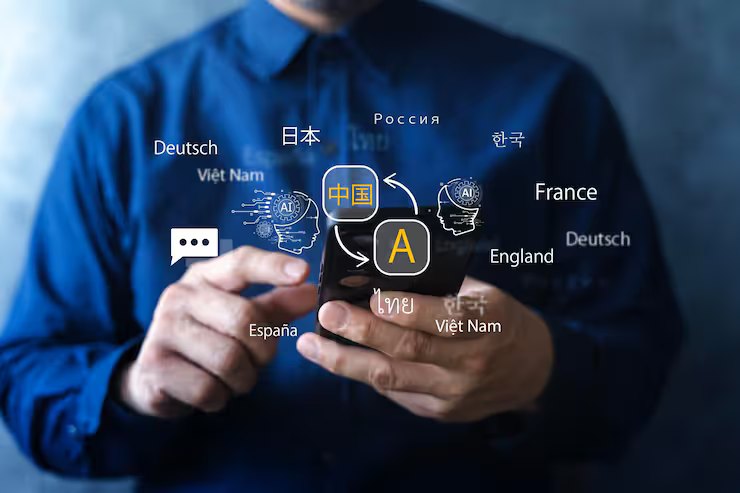
Their growing use reflects a broader shift toward real-time multilingual communication. Modern systems can work with written text, speech, images, websites, and other language-based content, making translation more integrated with everyday digital workflows.
Understanding how AI translation tools process language helps explain both their usefulness and their limitations. The quality of a translation depends on context, language structure, terminology, tone, and the technology behind the system.
How AI Translation Processes Different Languages
AI translation does more than replace individual words with equivalent words in another language. Modern systems analyze relationships between words and surrounding phrases to determine how a sentence should be interpreted.
Many advanced translation systems use neural machine translation and transformer-based language models. These technologies process sequences of language and identify patterns learned from large multilingual datasets.
For example, the meaning of a word can change depending on the sentence around it. A strong translation system therefore considers grammatical structure, nearby words, sentence relationships, and broader context rather than treating every word independently.
This contextual approach is particularly useful for languages with different word orders, grammatical structures, or expressions that do not have direct equivalents in another language.
Why Context Matters in AI Translation
Literal translation can produce grammatically correct sentences that still sound unnatural or communicate the wrong meaning. Context helps AI systems determine what the speaker or writer actually intends.
Consider a phrase such as "break the ice." Translating each word literally into another language may produce a confusing result. A context-aware system can recognize that the phrase refers to making people feel more comfortable in a social situation.
Context also influences tone. A sentence used in a legal document may require formal language, while the same basic message in a casual conversation may need a more conversational translation.
The surrounding material can provide clues about:
- The intended meaning of ambiguous words
- Formal or informal language
- Technical terminology
- Sentence relationships
- Cultural expressions
- The speaker's communication style
These factors make contextual processing one of the central capabilities of modern AI translation.
How Speech Translation Works
AI translation is increasingly used with spoken language rather than text alone. Speech translation generally involves several connected stages.
First, a speech recognition system converts spoken language into text. The resulting transcript is then processed by a translation model, which converts the meaning into the target language. In some applications, the translated text is subsequently converted into synthetic speech.
This workflow allows systems to support conversations involving different languages. It can also assist with meetings, presentations, travel interactions, educational material, and multilingual customer communication.
However, speech introduces additional challenges. Background noise, accents, overlapping speakers, unclear pronunciation, informal expressions, and rapid conversation can affect transcription accuracy before translation even begins.
For this reason, speech translation should be viewed as a connected pipeline rather than a single technological operation.
Handling Specialized and Technical Language
General conversation is only one area where translation is used. Organizations also work with specialized language in fields such as healthcare, engineering, finance, law, manufacturing, science, and information technology.
Technical terminology presents a particular challenge because many terms have precise meanings. A translation that is linguistically natural but technically incorrect can create serious confusion.
AI translation tools can improve consistency when they have access to appropriate terminology, reference material, or contextual information. Some enterprise systems can also be configured around organization-specific terminology and translation preferences.
Human review remains valuable when accuracy has significant consequences. Legal agreements, regulatory documents, medical information, safety instructions, and technical specifications may require professional linguistic and subject-matter review.
The Role of Multilingual Training Data
AI translation quality depends heavily on the language data used to develop and improve the underlying models.
Languages with large quantities of high-quality digital text often have more extensive training resources. Other languages may have fewer publicly available datasets, fewer digitized materials, or substantial variation across regions and communities.
This can create differences in translation quality between language pairs.
Language structure also matters. Some languages contain grammatical concepts or writing conventions that do not map neatly onto another language. Regional vocabulary and dialects can introduce additional complexity.
A translation model therefore does not simply learn a universal dictionary. It learns statistical and linguistic relationships from examples, which means the quality and diversity of those examples influence its performance.
Cultural Meaning and Localization
Translation and localization are related but different processes.
Translation focuses primarily on transferring meaning from one language to another. Localization goes further by adapting content to the cultural, regional, and practical expectations of a particular audience.
Dates, measurements, currencies, idioms, humor, names, formatting conventions, and references can all require localization.
For example, a marketing phrase that sounds natural in one country may feel awkward or inappropriate in another even when its literal translation is accurate. AI can identify many linguistic patterns, but cultural judgment often requires additional context.
This is why multilingual communication frequently benefits from combining automated translation with human review, especially when the content is public-facing or culturally sensitive.
Where AI Translation Tools Fit Into Everyday Work
AI translation can support many workflows without replacing every part of the translation process.
A business might use it to understand an incoming message written in another language before deciding whether professional translation is necessary. A researcher may use it to review foreign-language material during preliminary research. A customer-support team may use automated translation to communicate with customers across multiple regions.
Common applications include:
- Multilingual customer communication
- Document and website translation
- Speech and meeting transcription
- Educational content
- International collaboration
- Travel communication
- Research and information discovery
- Subtitles and media localization
The appropriate role depends on the importance of accuracy, the complexity of the language, and whether the translated material will influence an important decision.
Where AI Translation Still Has Limitations
Despite significant improvements, AI translation is not universally accurate.
One challenge is ambiguity. A sentence may have several possible interpretations, particularly when the original text provides little context.
Another issue is low-resource language coverage. Translation quality can vary considerably depending on the language pair and available training data.
AI systems can also struggle with sarcasm, humor, culturally specific references, unusual names, slang, and highly specialized terminology. A translation may appear fluent while subtly changing the intended meaning.
There is also a distinction between linguistic fluency and factual accuracy. A polished translation can still contain an incorrect interpretation of the original statement.
For high-stakes communication, human verification remains an important safeguard.
Choosing the Right Level of Human Review
Not every translated sentence requires the same level of oversight.
Informal messages and basic comprehension tasks may tolerate occasional imperfections. Public documents, technical instructions, legal materials, medical information, and regulatory content generally require more careful review.
A practical workflow can divide translation tasks according to risk.
Low-risk material may be translated automatically and reviewed only when needed. Medium-risk content can receive targeted human editing. High-risk material may require professional translators or subject-matter specialists to verify terminology, meaning, and context.
This approach recognizes that AI translation is a tool within a communication process rather than an automatic guarantee of perfect equivalence.
What Multilingual Communication May Look Like Next
The development of AI translation is moving toward more integrated communication systems. Translation is increasingly connected with speech recognition, language understanding, document processing, transcription, and conversational interfaces.
The direction of development is not simply about translating more words. It involves improving contextual understanding, supporting more languages, handling specialized terminology, and reducing the delay between speaking and receiving a translated response.
At the same time, responsible use will require attention to privacy, accuracy, cultural context, and human oversight. Organizations handling sensitive information also need to understand how translated content is processed and protected within their chosen systems.
Conclusion
AI translation tools have evolved from simple word-substitution systems into sophisticated technologies capable of analyzing context, grammar, speech, terminology, and multilingual relationships. They can make communication across language boundaries faster and more accessible across many everyday and professional situations.
Their effectiveness, however, depends on the language pair, content type, available context, and required level of accuracy. The most practical approach is to treat AI translation as a powerful communication aid while using appropriate human review when precision, cultural nuance, or professional consequences matter.