Heavy duty industrial conveyor systems play a central role in facilities that move large, heavy, abrasive, or continuously flowing materials.
From bulk minerals and aggregates to packaged goods and manufactured components, these systems provide a controlled way to move materials between processing, storage, loading, and production areas.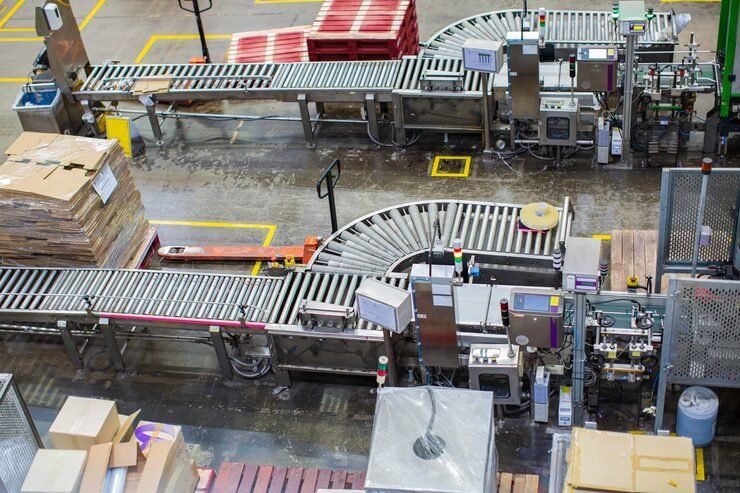
Modern industrial operations often involve long transport distances, high throughput, irregular loads, and demanding working environments. Conveyor equipment must therefore be selected around the material being handled, the required movement pattern, operating conditions, and integration with surrounding machinery.
Understanding the major conveyor types makes it easier to distinguish where each design fits. The right system depends on factors such as load characteristics, belt or conveying surface, incline, transfer points, speed requirements, and the amount of automation involved.
Why Heavy Duty Conveyors Are Designed Differently
Heavy duty conveyor systems are built for operating conditions that can place substantial mechanical stress on equipment. Large loads, abrasive materials, continuous operation, impact during loading, dust, moisture, and temperature variations can all affect conveyor performance.
A system designed for lightweight packages may not withstand the forces generated by crushed rock or bulk mineral handling. Heavy duty equipment typically incorporates stronger structural frames, appropriately sized drive components, reinforced conveying surfaces, robust bearings, and carefully engineered support arrangements.
The conveyor is also rarely an isolated machine. It usually forms part of a larger material-handling process that may include crushers, screens, hoppers, feeders, storage systems, palletizing equipment, or loading infrastructure.
Key Types of Heavy Duty Industrial Conveyor Systems
Different conveyor configurations solve different material-handling problems. Choosing between them requires understanding how each design transports material and where it performs effectively.
Belt Conveyors
Heavy duty belt conveyors are among the most widely used systems for transporting bulk materials and large loads. A continuous belt travels around pulleys while carrying material along a predetermined route.
They can be configured for relatively short transfers or extended conveying routes. Troughed belts are commonly used for bulk materials because the belt profile helps contain material during transport.
Typical applications include:
- Mining and mineral processing
- Aggregate handling
- Cement and construction materials
- Power generation facilities
- Ports and bulk terminals
- Large-scale manufacturing
Belt conveyor design can vary considerably depending on belt width, material density, conveying distance, incline, loading conditions, and required throughput.
Chain Conveyors
Chain conveyors use one or more chains to move loads along a defined path. Their mechanical construction makes them particularly suitable for heavy discrete loads that may be difficult to transport on conventional roller equipment.
They are frequently used for pallets, containers, fabricated components, industrial assemblies, and other rigid loads. Chain conveyors can also be integrated with transfer mechanisms where loads need to change direction or move between conveyor lines.
Their design must account for chain tension, sprocket engagement, load distribution, lubrication, and the characteristics of the transported material.
Roller Conveyors
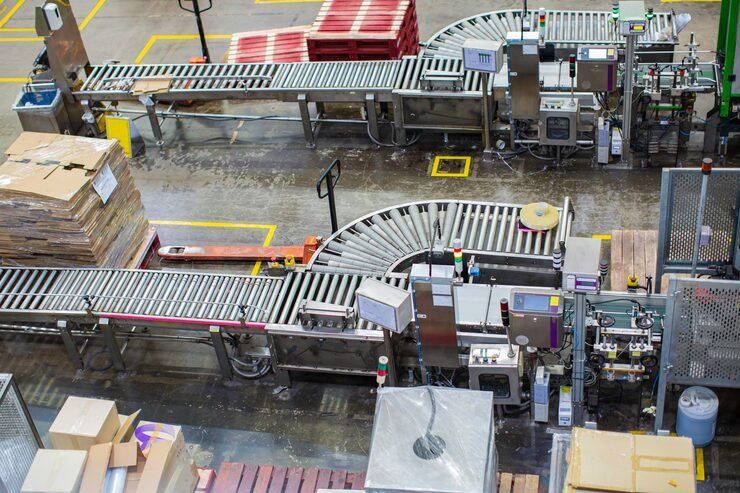
Heavy duty roller conveyors use cylindrical rollers positioned along a supporting frame. Depending on the configuration, rollers may be powered or rely on gravity to move the load.
Powered roller conveyors are useful where consistent movement and controlled accumulation are required. Gravity roller systems can be appropriate for certain material flows where elevation differences provide the necessary movement.
These conveyors are commonly associated with manufacturing, warehousing, distribution, fabrication, and pallet handling.
Apron Conveyors
Apron conveyors use overlapping metal or reinforced plates attached to chains. This construction provides strong resistance to impact and makes apron systems suitable for heavy, coarse, or irregular materials.
They are often found around crushing and processing equipment where large pieces of material can fall onto the conveyor with considerable impact. Apron conveyors can also handle materials that would cause significant wear on lighter conveying surfaces.
Their operating characteristics make them particularly relevant for demanding bulk-material environments.
Screw Conveyors
Screw conveyors move material through a trough or enclosed housing using a rotating helical screw. They are particularly useful for controlled movement of powders, granules, sludge, and other bulk materials.
Unlike long-distance belt conveyors, screw conveyors are often used for relatively contained transport and can perform additional functions such as controlled feeding or material mixing.
Design considerations include screw diameter, rotational speed, material properties, inclination, moisture, temperature, and potential buildup within the conveying enclosure.
Matching Conveyor Design to the Material
Material characteristics are one of the most important factors in conveyor selection. A system designed without considering the physical behavior of the material can experience excessive wear, spillage, blockages, or unstable flow.
Engineers commonly consider properties such as:
- Bulk density
- Particle size and shape
- Abrasiveness
- Moisture content
- Temperature
- Flowability
- Impact characteristics
- Required throughput
For example, sharp and abrasive aggregate can create substantially different wear conditions from dry granular material. Sticky or wet material can also behave differently at transfer points and may require specific belt profiles, cleaning arrangements, or enclosure designs.
The material's behavior should therefore be considered throughout the complete conveying route rather than only at the loading point.
Applications Across Industrial Operations
Heavy duty conveyors appear in many industries because continuous mechanical transport can connect separate stages of a production or processing system.
In mining, conveyors move ore, coal, overburden, and processed minerals between extraction, crushing, screening, stockpiling, and loading areas. Long conveyor routes can connect geographically separated parts of a facility or mine site.
In aggregate processing, conveyors transport crushed stone, sand, gravel, and recycled construction materials between crushers, screens, stockpiles, and loading areas.
In cement and bulk-material operations, conveying equipment moves raw materials and processed products through different stages of handling. Enclosed systems can also help control dust where appropriate.
In manufacturing, conveyors may transport components, assemblies, pallets, and finished products between production stations. Their configuration can be closely integrated with automated handling and production equipment.
In ports and terminals, heavy conveyor infrastructure can support continuous movement of bulk commodities between storage areas and loading or unloading equipment.
The application determines much of the conveyor's mechanical design, including capacity, layout, support structure, drive arrangement, and material-contact components.
Transfer Points and System Integration
A conveyor's performance depends on more than the main conveying section. Transfer points can have a major influence on material flow, wear, dust generation, and maintenance requirements.
At a transfer point, material moves from one conveyor or processing machine to another. Poorly designed transitions can create excessive impact, material spillage, belt mistracking, blockages, and accelerated component wear.
Well-designed systems consider the direction and velocity of incoming material, chute geometry, loading location, belt speed, and containment. In large facilities, these details become particularly important because a problem at one transfer point can disrupt several connected processes.
Conveyors may also be integrated with sensors, variable-speed drives, programmable controls, emergency stopping systems, and monitoring equipment. These technologies can help operators track operating conditions and coordinate material flow across interconnected equipment.
Reliability, Maintenance, and Safety Considerations
Heavy duty conveyor equipment operates under substantial mechanical loads, so preventive maintenance is an important part of system management. Inspections commonly focus on belts, chains, rollers, bearings, pulleys, drive components, structural supports, and material buildup.
Wear patterns can provide useful information about developing problems. For example, unusual belt wear may indicate tracking problems, loading issues, misalignment, or component deterioration.
Safety engineering is equally important. Conveyor systems can contain moving belts, rotating shafts, pinch points, and other mechanical hazards. Appropriate guarding, emergency-stop arrangements, access controls, inspection procedures, and worker training should be incorporated into the overall system design.
Applicable machinery and workplace safety requirements vary by jurisdiction and application, so system designers and operators need to consider the standards governing their specific facility.
Choosing the Right Conveyor Configuration
There is no single conveyor design that fits every heavy duty application. A practical selection process starts with the material and operating environment, then works toward the required conveying arrangement.
Important questions include:
- What material or load will be transported?
- How heavy, abrasive, hot, wet, or irregular is it?
- What throughput is required?
- How far must the material travel?
- Is the route horizontal, inclined, or changing direction?
- How will material enter and leave the conveyor?
- What environmental conditions will the equipment face?
- How will inspection and maintenance be performed?
- What safety requirements apply to the installation?
These factors help determine whether a belt, chain, roller, apron, screw, or combination system is appropriate.
In larger installations, the conveyor should be considered as part of the complete material-handling architecture. A technically capable conveyor can still perform poorly if upstream feeding, downstream receiving, transfer points, or controls are mismatched.
Frequently Asked Questions
What makes a conveyor system heavy duty?
Heavy duty conveyors are engineered for demanding loads, continuous operation, abrasive materials, high impact, or harsh industrial environments. Their structural and mechanical components are generally selected for greater operating loads than lighter material-handling equipment.
Which conveyor is commonly used for bulk materials?
Belt conveyors are widely used for bulk material transport because they can handle substantial throughput and can be configured across long conveying distances. The appropriate design depends on the material and operating conditions.
Are heavy duty conveyors used only in mining?
No. Mining is a major application, but heavy duty conveyor systems are also used in aggregates, cement, manufacturing, ports, power generation, recycling, and other industrial operations.
Why are transfer points important?
Transfer points determine how material moves from one piece of equipment to another. Their design can influence spillage, impact, dust, wear, blockages, and overall material flow.
What affects conveyor maintenance requirements?
Load characteristics, operating hours, material abrasiveness, environmental conditions, alignment, component quality, loading conditions, and maintenance practices can all influence maintenance requirements.
Conclusion
Heavy duty industrial conveyor systems are fundamental components of large-scale material-handling operations. Their designs range from belt and chain conveyors to rollers, apron systems, and screw conveyors, with each configuration suited to different materials and operating conditions.
Effective conveyor selection requires more than considering load capacity. Material characteristics, route geometry, throughput, transfer points, system integration, maintenance access, and safety all influence long-term performance. When these factors are evaluated together, conveyor infrastructure can provide a controlled and dependable connection between major stages of an industrial process.